


On 9 April 2026 the OECD released the 2025 Official Development Assistance (ODA) early figures, confirming a worrying trend. For the third consecutive year, EU Member States are cutting their aid spending. In 2025, 17 EU Member States cut their ODA. Read more in the CONCORD Europe Press release, called ‚The EU Sails Away from International Cooperation with the Biggest Aid Cuts in a Decade.‘
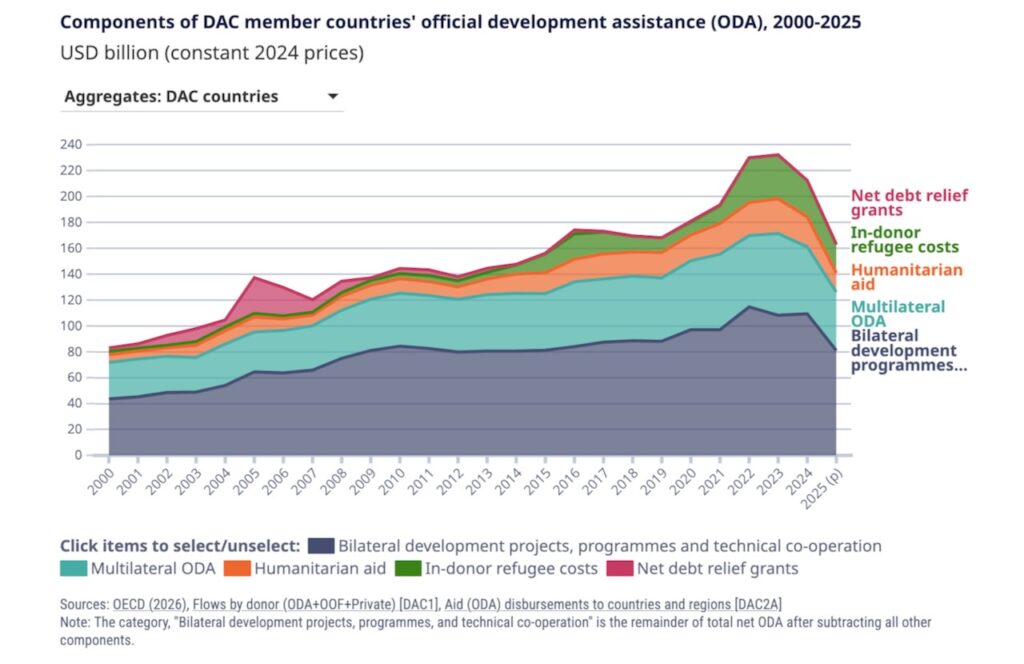
Since 2024, EU Member States contributions have dropped by 9.9 per cent. These cuts will cause direct damage in Least Developed Countries (LDCs) and fragile contexts. In 2024, LDCs received only 14.% of ODA grants from EU Member States and 18.3% from EU Institutions. This means that while inequalities are growing, the EU is diluting its support, going against the core purpose of international cooperation.
In order to support the reduction of poverty and inequalities the EU should dedicate more ODA to sectors like health, education and social protection, but today’s figures show another path being taken. They confirm EU institutions are accelerating a downward trend, slashing their ODA by 13.8 per cent in 2025. This is the biggest cut in EU Institutions’ ODA in a decade.
These cuts are not happening in isolation. Amid a global wave of aid cuts, they underscore an intention from the EU’s to redefine the core purpose of international cooperation. EU institutions describe this direction as “paradigm shift”, a concept already shaping the proposals for the upcoming 2028-2034 EU budget. As the “paradigm shift” attempts to redraw the map of EU cooperation, EU Institutions and Member States should keep the consequences in mind.
“The EU is giving fewer grants to the countries that need them the most. At the same time, international cooperation is increasingly designed to benefit European companies. As the focus shifts to pursuing multiple agendas with a shrinking budget, Majority World partners are left navigating the EU’s incoherence.” – Corentin Martiniault, Policy Analyst and Advocacy Officer, Coordination Sud

In 2024, CONCORD made clear that cuts to ODA budgets were a choice, and today’s figures prove that these choices come at a cost. EU Institutions and Member States might present this shift to “mutual interest” as an opportunity to explore new waters, but this comes at the expense of disproportionate cuts to ODA budgets precisely in areas of highest priority, where human development is most needed.
With negotiations ongoing on the future EU budget for international cooperation from 2028 onwards, NGOs warn that the Global Europe Instrument risks taking the EU down a worrying current: abandoning ODA. However, it is exactly now that EU decision makers have the opportunity to set a clearer route towards a sustainable international cooperation.
We will talk more about this worrying trend at the Ambrela development forum (ADF) in October 2026.
Copyright 2026 Ambrela - Platform for Development Organisations. This site is funded by ČR via CzechAid, SR and EU under the Programme Slovakia. Ambrela is solely responsible for its content and does not necessarily reflect the views of the donors.